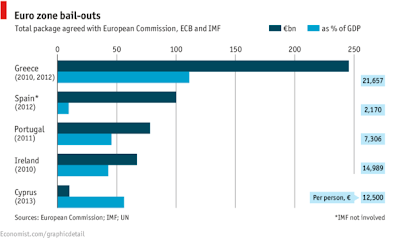
After the latest Cyprus deal has gone through, it's time to compare it with all other Eurozone bailouts done in the previous two years:
 |
| Source: The Economist |
Greece is still leading the pack with a combined stimulus effect of over 100% of its GDP, and 21,000 bailout funds per capita. With the latest Cyprus deal they fall behind second to Greece in the magnitude of the bailout with respect to a country's GDP. It would also be interesting to show Iceland in the graph (or Hungary), as they had similar bailout-to-GDP ratios as Cyprus, except they received help from the IMF (and other Nordic and European countries), not the Eurozone.
In absolute terms, the bailout of Cyprus is rather small compared to other Eurozone economies (due to the size of their $25bn, 1.1m people economy). However, this shouldn't be an excuse as to why Greece was bailed out more or less in full, with several years of painful negotiations and forcing bondholders to accept the losses, while Cyprus was to be set as a precedent and having had to levy the burden directly on the people's savings (all those over a €100,000), who had nothing to do with their banks' poor decisions. Does that imply that Cyprus was another stress-test to the system? Like Lehman in America? Let's see what happens if we allow for some smaller country to actually leave the euro (Greece was, I assume, too big, as possible contagion onto Portugal, Spain or Italy was too high of a price to pay). Let's see will we be able to bear the consequences. It's dangerous to mess with peoples' lives this way, particularly if the people had nothing to do with the current contagion, since it wasn't them who made bad decisions nor took on a considerable amount of risk while investing into Greek bonds.
For the situation to be even more absurd, the contagion in Greece is directly responsible for the collapse of the banking industry in Cyprus, as Cypriot banks were closely tied to the financial system in Greece (funded by money from Russia, and traditional domestic savings). Even more absurd, Eurozone's solutions in helping Greece by forcing the losses on the bondholders were a necessary cause of Cyprus pains (or at least contributed to the worsening of Cyprus pains). I'm not saying this is was necessarily a faulty solution, but isn't it ironic that Eurozone policymakers' ideas that were designed to help Greece were partially responsible for the current troubles in Cyprus? And now once again, they must apply one-off fire-extinguishing measures hoping they will work, while having no idea how they will actually turn out. That's what generally happens when one doesn't fully think through all the consequences of poorly devised ideas. Who knows what kinds of future instabilities will arise from all those bailouts given to the aforementioned countries? Eurozone's politicians surely don't.
Finally, looking at the graph above, I can't seem to shake off the fact that way too much money was spent to get all these economies in order and force them to engage into reforming their unsustainable systems, particularly since we are able to witness the outcomes. So far, terrible value for money.